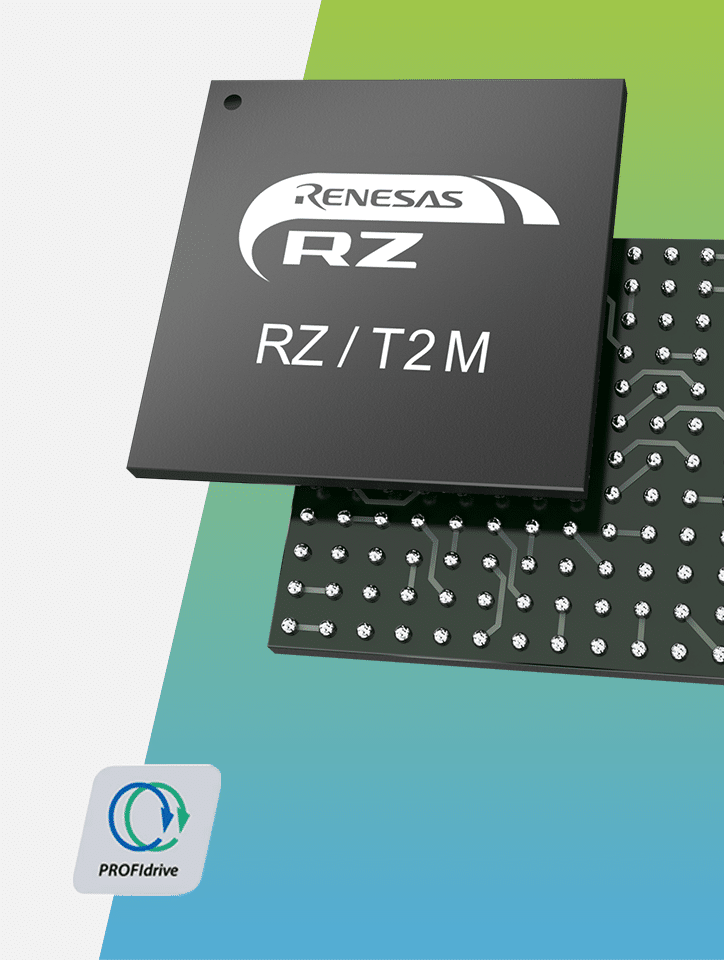
PROFINET in your product.
No detours.
For chip and device manufacturers
We bring PROFINET to your target hardware – stack-neutral, from the concept phase through porting and integration to the passed certification test. You stay in control of schedule, budget and roadmap.
[…] Based on its many years of experience with PROFINET and PROFIdrive, Codewerk has shown us a complete professional solution which creates genuine added value for our customers and for us.
Helge Peters, System Design Manager at Renesas Electronics
Want your devices to speak PROFINET?
Then you have come to the right place
PROFINET is a given in factory automation: anyone building chips, controllers or field devices has to support IO controller, IO device or IO supervisor reliably, with full diagnostics and with certification. But that expertise does not build itself on the side – and your start of series production will not wait.
Does this sound familiar?
Many chip and device manufacturers lose time and budget because they …
- … buy in a stack and are then left alone with integration, conformance class and diagnostics.
- … only start testing at the end of the project – and get stuck in certification, shortly before series production is due to start.
- … commit to a solution that cannot keep up with later requirements such as PROFINET over TSN.
These are exactly the risks we take off your hands.
We support chip and device manufacturers vendor-neutrally, from stack selection through integration and automated testing to passed certification – in close cooperation with the established manufacturers and test laboratories, backed by the know-how of more than 10 years in industrial communication.
PROFINET integration with Codewerk is …
We reduce the complexity of your project – thanks to many years of experience in industrial communication.
We lower your schedule and budget risk – thanks to proven tools and methods such as continuous integration.
We prepare you for future requirements – with stacks from Siemens or PI, for example PROFINET over TSN.
We take care of design, implementation, integration and certification for you –
all from a single source.
Looking for a partner for your PROFINET integration?
Tell us about your project – we will get back to you with an initial assessment.
We find the right stack for your requirements
Stack-neutral: from established stacks to the open-source PI Community Stack, we choose the basis that fits your project’s hardware, schedule and budget.
Current trend PI Community Stack
The PI Community Stack is the open-source implementation of the PROFINET protocol – maintained by PROFIBUS & PROFINET International (PI). We port, integrate and certify it vendor-neutrally on your target hardware.
This frees you from stack licenses and from dependence on a single supplier. The basis is developed further and maintained long term by the entire PROFINET community – free of charge for PI members, with no per-device fees.
And it fits into smaller devices than you might think: we have reduced the memory footprint so far that the stack runs with less than 1 MB of RAM in the internal memory of a modern MCU – without an external memory chip.

Conformity classes and profiles – we cover them all
The various conformity classes CC-A, CC-B, CC-C and CC-D are essential for real-time communication and meet the requirements of a wide variety of systems and applications. The higher the class, the more demanding and time-critical the applications in which the PROFINET device can be used.
As the leading industrial Ethernet standard supported by PROFIBUS & PROFINET International (PI), PROFINET is based on established IT standards such as TCP/IP, thus creating the foundation for future-proof and interoperable industrial communication.
Our PROFINET profile support

PROFIsafe enables safe communication in automation networks and ensures protection against hazards caused by faults or malfunctions.
PROFIdrive is a standard for the communication of drive systems in industrial networks and ensures the integration of different drive types.

PROFIenergy combines energy management with automation. The profile helps to analyze and reduce energy consumption.
PROFIprocess ensures reliable transmission of process data and supports the automation of complex processes.
PROFINET over Ethernet-APL
PROFINET over APL takes the protocol to where 4–20 mA and PROFIBUS PA used to sit: into the field of the process industry. A single wire pair carries data and power at the same time, over several hundred meters and intrinsically safe into the Ex zone.
For chip and device manufacturers, different rules apply there than in the factory. Plants run for decades and must not be shut down to replace a device, the control system is designed redundantly, and a transmitter has to be replaceable across vendors. PROFINET covers this with PA Profile 4 and conformity class CC-B (PA).
We have already commissioned the PI Community Stack on APL reference hardware.
Not sure yet whether we are the right fit for your project?
Let us clarify that in a first conversation, with no obligation.
Steps of a successful PROFINET integration

- ➤Requirement analysis
- ➤Definition of required PROFINET features
- ➤Stack evaluation
- ➤Definition of the software architecture
- ➤Engineering concept
- ➤Stack migration to customer HW
- ➤Stack integration into existing firmware
- ➤Implementation of data mapping & exchange
- ➤Implementation of GSDML file
- ➤Stability testing
- ➤Performance testing
- ➤Processing all certification tests defined by PI
- ▸SPIRTA
- ▸ETS/ART
- ▸NETLOAD
- ▸Profile tester
- ▸Manual tests
- ➤Bug-fixing
- ➤Organization of product certification at a registered laboratory
- ➤On-site support of certification process
- ➤Handover of official certificate by PNO/PI
3 plans
You determine the level of cooperation
Basic Integration Suite
“Design with you”
- Consulting and support of design & software architecture
- Integration & implementation
- Test & certification
Collaborative Integration Suite
“Build with you”
- Working together in close exchange
- Implementation of all PROFINET-relevant modules by Codewerk
- Integration into the device application by the customer
Comprehensive Integration Suite
“Build for you”
- Independent implementation of all project steps – perfectly tailored to customer requirements
- From first concept to successful certification
Any questions left about our offer? We are happy to answer them.
FAQ
What customers ask before placing an order
That depends on target hardware, feature set and conformity class. As a rough guide: one documented case using the PI Community Stack took around three months to a certified device in conformity class A. On top of that comes the laboratory slot itself – two to six weeks of lead time, around three test days for a standard device, with the certificate following about two weeks later.
We will give you a concrete estimate for your project after the first conversation.
The target hardware and the knowledge about your application – that is, what data your device provides and how it should behave.
From us come stack selection, porting, integration, GSDML creation, testing and support at the laboratory. How much of that stays with you is your choice, through the three plans.
Testing takes place at an accredited PI test laboratory. Every laboratory has its own price list, and PI charges a fee for issuing the certificate. Those costs do not sit with us.
Our share depends on the plan you choose.
Yes, that is a common case. Usually it concerns a device that has failed the pre-test or the laboratory test.
We look at what it is hanging on – often it is edge cases such as I&M records, timing or the interplay with the platform’s network stack, not the protocol itself.
For the PI Community Stack, yes – it is provided to members under a licence agreement and can be used by them without licence fees. For commercial stacks it depends on the vendor.
Which route is cheaper for you is something we clarify during stack selection.
GSD files (General Station Description) are at the heart of the integration of PROFINET devices into a PROFINET network. They contain all relevant information about the properties, functions, and communication options of the respective PROFINET devices.
For users, this means: The files can be used to integrate and configure new devices into the existing network. GSD technology is an essential part of the PROFINET architecture and ensures that the integration of new components runs smoothly and efficiently. With these files, the PROFINET network is scalable and can be expanded or modified even as requirements change.
Reliable PROFINET diagnostics are crucial for the trouble-free operation of your PROFINET networks. With modern diagnostic tools, users can monitor the status of all network participants, detect communication problems early on, and fix them in a targeted manner.
Diagnostics includes analyzing the network and then identifying and fixing errors. This is an important step in making sure your systems are available and performing well.
Effective PROFINET diagnostics and troubleshooting minimize downtime and ensure the long-term productivity of your systems.
Although Ethernet and PROFINET are closely related, they are not the same thing. Ethernet is a basic standard for data transmission in networks and is used in almost all areas of IT. It primarily defines how devices exchange different types of data in a local network.
PROFINET, on the other hand, is a communication protocol that was developed specifically for industrial applications. It is used in automation technology to connect controllers – such as programmable logic controllers (PLCs) – to sensors or other devices.
PROFINET uses the physical infrastructure of Ethernet, i.e., the same cables and switches, but differs fundamentally from Ethernet in the way it communicates.
IRT (Isochronous Real Time) is an extended form of PROFINET that was developed for particularly demanding applications with very strict real-time requirements, such as those required in motion-synchronous drive applications, for example in robots, CNC machines, or packaging systems.
Unlike conventional PROFINET RT, IRT ensures that data transmission is precisely timed – and by that we mean accurate to the millisecond.
While PROFINET RT runs on standard switches and infrastructure, IRT requires specially designed hardware, such as IRT-enabled switches and devices with an integrated synchronization mechanism.
PROFIBUS and PROFINET are both industry standards for communication in automation technology, but they differ fundamentally in their technical basis and in how they are used.
PROFIBUS (Process Field Bus) is a serial fieldbus established since the 1990s that is based on RS-485 technology. It uses a master/slave communication principle and is particularly suitable for classic automation tasks such as controlling sensors and decentralized devices.
PROFINET (Process Field Network), on the other hand, is based on Ethernet technology and was developed to meet the growing demands for speed, flexibility and integration into industrial networks.
Maximum flexibility
Strategic partners
We are stack-neutral. This means that we are not tied to a specific manufacturer, but can select the technologies best suited to your requirements. We are particularly familiar with the solutions of our strategic partners.
Through close cooperation with various manufacturers, we can select systems and components specifically according to their functionality, thereby optimally exploiting the advantages of modern Industrial Ethernet networks for your applications.




Partnership
Renesas
For designs based on RA and RX MCUs as well as RZ MPUs, we take on the system integration of PROFINET and other industrial fieldbuses: evaluating and adapting the stack, the PI Community Stack for example, integrating it into the operating system or RTOS, and implementing the application and host processor interfaces. This also covers GSDML creation, test and validation, and hardware and software certification through PI-registered laboratories.
Codewerk on renesas.com